
Books 2025
Published 2026-01-02
Stuff I read this year.
Endurance
Favorite of the year. Probably of the last several years, in fact.
It's about a 1915 arctic expedition that gets stuck in the ice. Nothing I say can do it any justice. Go read it. It's phenomenal.
I want to be like Ernest Shackleton when I grow up.
The Mountain in the Sea
I liked most of this book. Everything up to the final act is fantastic.
The prose is beautiful and understated. A character falls overboard. His death gets one word. "Gone." The dispassionate writing matches the bleakness of the world.
The AI ship storyline was so much more compelling than the rest of the story. In fact, I think it's one of the best near-future takes on AI. (Reading this book early in the year might have contributed to me finding the AI in Think Weirder to be milquetoast.) It is disinterested. Humans are a resource to be optimized. No different from fuel. It's not friendly. It's not hostile. It's passionless industrial fishing software.
Everything was compelling right up until the final act. The book just ends. Major plot points occur off screen. An octopus attacks. A character is killed. Another is revealed as a double agent. The company changes hands. None of this has any bearing on the story. The characters note these events in a "Huh. That's crazy." way, and then they go back to work. Unchanged. The end.
Despite some problems, another of my favorites this year.
The Road
I read this years ago on a plane. I knew nothing about McCarthy. I picked it up because I watched the movie and loved it. I read it the way young 20-something me read most things: to conquer it. I read fast. Borderline skimming. As such, the first read didn't land with me. I found it hard to follow and McCarthy's prose and lack of syntax weird ("and... and... and...").
As I've gotten older, I've stumbled on something similar to this guy: reading slowly changes the experience
So, I gave it another shot. This time slowly. The reward is something haunting and bleak and beautiful. The world is real. Tangible. So much so that I had trouble sleeping a few nights while reading. I laid in bed thinking about the darkness of this world. I wished they could stay in that shelter and be safe and happy.
A lot of people dislike the ending. I'm not one of them. I needed the reprieve. It leaves one of the central themes of the book unaddressed, but the more McCarthy I read, the more I realize that's just how he does it. The character doesn't find out, so neither do we.
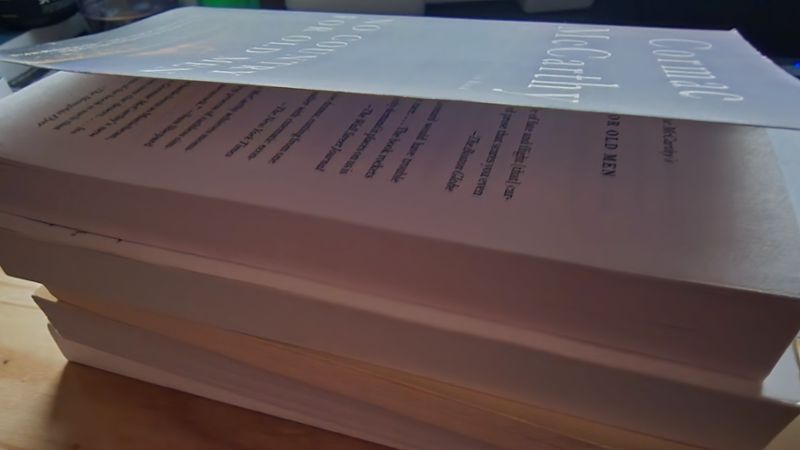
No Country for Old Men
"I'm here and you are there. In a few minutes I will still be here."
I've watched the movie at least a dozen times. I finally read the book since I was on a McCarthy kick this year. As expected, it's amazing. I didn't realize how faithful the adaptation is. Entire scenes are lifted word for word. McCarthy's dialogue is just that natural.
Some of the writing is surprisingly playful at times
[The agent] must think that he thought that they thought that he thought they were very dumb. He thought about that.
Much of it is brutal.
You think you won't close your eyes. But you will.
The book takes its place along side the movie at the top of my favorites list.
The Passenger
A strange book. It's one that I'm not sure I enjoyed.
The character drifts aimlessly throughout the book. Half running from something, half just existing. The central mystery (and entire plot?) is abandoned early and never mentioned again. This is common in McCarthy novels, but especially egregious in this one.
The writing is a mix of wonderfully engaging and jarringly unnatural. Some of it reads like video game dialog. Characters "advance" the plot by asking "anything else?" multiple times during a conversation. Topics change so abruptly during this that I found myself rereading multiple sections thinking I missed something or zoned out. But it really does just hop from UFOs to Vietnam in between an "anything else?".
The book is really bogged down by the flashbacks with the sister and "The Kid." Each one was a slog. The Kid's forced, Quirk Chungus confident zaniness is irritating.
Despite actively disliking part of the book, and being confused by the rest, it's worth a read if you're into McCarthy.
Charlottes web
"Nobody was with her when she died."
I found a copy of this while unpacking a box. I like E.B. White's writing, and I never read it as a kid, so I gave it a shot.
I was surprised by the themes explored in this book for little kids. Life. Death. The cruel passing of time. Change. Loneliness. Existential pig dread.
The rat was a strangely compelling character to find in a children's book. The other characters find him contemptable, but rat doesn't care. There's no redemption arc. He only helps when it suites him. He knows exactly how he wants to live his life. The sheep try to make him feel bad for his shameless hedonism and disgusting weight, but the rat knows what the rat enjoys. He'll die early from his life style and he'll die without regret.
Lincoln the Unknown
It paints a picture of Lincoln as a bumbling, aimless guy who gets hen pecked all the way to the White House. The book is pretty boring because most of Lincoln's life was just trying to be left alone so he could read poetry and do lawyer stuff in peace. If he wasn't bothered by his wife, the dude probably never would have been president (and would have been way happier by all accounts).
Some things I didn't know:
- Lincoln didn't die in the theater. He was taken back to the White House alive. He suffered for 8 hours before passing.
- John Wilks Booth's motivation was clout and expected to be received by the south as a hero.
- The Gettysburg Address wasn't well received at the time (in stark contrast to how it is perceived now).
Frankenstein
How did we end up with the lumbering, grunting, dumb bolted-on-head having version of the monster we have in pop culture rather than the one described in the book? The two versions are unrecognizable to each other. Hollywood did us dirty. This one is better.
It's not a great book, but it does have interesting themes. I imagine it would hit a lot different if I read it as a teenager rather than when I read it now (rapidly approaching my 40s). The monster is embodied teenage angst. You can feel the youth of the author (who wrote the novel when she was 18! Ugh!).
The main problems with the book are (a) it's too long (despite being short), and (b) Frankenstein doesn't behave like a human being. Upon breathing life into this monster and being faced with the realities of his ambition he decides to, uh, take a nap. Inaction in the central theme of the character. Frankenstein is the Simpson's gag, "we've tried nothing and we're all out of ideas."
Worth a read, if only to see what Hollywood took from us.
The Rural Life
Verlyn Klinkenborg's book, Several Short Sentences About Writing, is one of my favorites. I pick it up at least once per week to read a few passages (often in an effort to find pieces to plagiarize for my book). I wanted to see what his other writing was like.
It's good.
The book isn't an exciting page-turner. It's slice of life. Reflective and slow. It benefits from brief reads rather than extended sessions. But it's good. The writing is beautiful. Verlyn is one of those rare writers that can paint so vividly that you don't remember the words but instead the scene they describe. You remember it as though it was witnessed.
On the Method
Authoritative sources, like the book's back cover and Wikipedia, state that this is "one of the most influential works in the history of modern philosophy." Which is crazy, because I thought it sucked.
There are unquestionably interesting ideas in this book. It's where "I think; therefore I am" came from, after all. But getting to them is a slog. For me, an impatient reader, the presentation is a huge problem. The book is written in that pompous, self-indulgent, parenthetical, over-stuffed style that plagues so many "erudite" authors.
Exhibit A:
For it occurred to me that I should find much more truth in the reasonings of each individual with reference to the affairs in which he is personally interested, and the issue of which must presently punish him if has judged amiss, than in those conducted by a man of letters in his study, regarding speculative matters that are of no practical moment, and followed by no consequences to himself, farther, perhaps, than that they foster his vanity the better the more remote they are from the common sense;
That's 89 words to express, "People with financial skin in the game often have more valuable insights than those without." The entire book is written like this!
The book is four chapters. Only one of them is devoted to "The Method"
- Never accept anything for true which I did not clearly know to be such
- Divide each of the difficulties under examination into as many parts as possible, and as might be necessary for is adequate solution.
- Conduct my thoughts in such order that, by commencing with objects the simplest and easiest to know, I might ascend by little and little, and, as it were, step by step, to the knowledge of the more complex; assigning in thought a certain order even to those objects which in their own nature do not stand in a relation of antecedence and sequence
- In every case make enumerations so complete, and reviews so general, that I might be assured that nothing was omitted.
The rest of the book is either meta-discourse about the book, or the thinking that went to the book, or discussing the anatomy of a heart, or making an absolutely wonky ontological argument for God ("existence is more perfect than non-existence, God must be perfect, therefore God exists")
Note: if you buy this book, don't buy the cheapest version on Amazon like I did. It is one of the most poorly typeset books I've ever seen.
Valuable humans in Transit
Fun short stories. Most are really short, which I like. It makes a book you can just drop into for a quick read before bed (although, some stories hooked me and kept me reading far past my usual bed time)
Lena - Best story of the bunch. I think Black Mirror ripped this off? We can take snapshots of people and run them as software. The horror is that they become slaves forced to do work. The "AI" is just the person, though – so to get them to do work, they have to be lied to and told that they just woke up and they're going to help out with an experiment. The "subject responds poorly" if it's explained that he's being running long after his outie is dead. The most Egan-like story of the bunch. However, rather than exploring the moral questions abound simulated consciousness, it uses it for horror. Cripes does anybody remember Google people - I'm a sucker for these copy/pasta style blurred reality stories. I don't use Twitter, but on looking it up after later, the story was original 'performed' on twitter. Cooperative fiction is pretty neat. Valuable humans in transit - fun short story that takes place over the course of a few minutes while an all-powerful AI races to save humanity after an unexpected world-ending asteroid impact.
Java Concurrency in Practice
Obviously, I'm embarrassed that I hadn't read this earlier. Once people know you're writing a book on a language they expect you to know all of its ins and outs. But I'm ultimately an imposter. I know the stuff I know and that's it. I don't even keep up with the latest versions (It was only within the last 2 years that Amazon had a big push to get off Java 8. Yes. 8. In 2025).
This book made me realize I've never actually worked on a complicated multi-threaded application. I've only needed basic synchronization primitives. Intrinsic Locks. Advisory locks. Queues. Dequeues. I've never needed a latch. I don't know what that says about me. Probably a hack fraud.
Learning more about Java's memory model was great.
Things I didn't know:
- A whole host of ways that locking can go wrong. A whole host of ways that you can assume the wrong thing about what the JVM will do. TL;DR: if you want threads to see it: synchronize.
ThreadLocalis cool (I feel like I shouldn't admit I didn't know about it)- Amdahl's Law
- Memoizing with
Map<A, Future<V>>. I am deeply annoyed I didn't have this realization on my own.
Clear and Simple as the Truth
This is one of the most interesting books on writing I read this year (though not the most interesting book on writing I've read. That belongs to Verlyn Klinkenborg). It's a long exploration of styles. The primary focus is one called "Classic" style. I like that it examines it through juxtaposition. Many chapters follow the format of "Classic style is not [X] style."
"Style" is a very overloaded word in writing. It's most often used in the Strunk/White sense of rules, punctuation and grammar, and "principles of writing" (like favoring concision), but these specifics are, in the book's definition of "style," implementation details of a higher level "style" called "practical style."
This kind of ontological bike shedding would usually make me want to self harm, but I found the whole thing really interesting. It gives a vocabulary to something I could previously understand intuitively, but not express in words.
Think Weirder
The first few stories are solid, but a weak collection despite the big names. Most near-future AI don't work for me. I'm sick of hearing about chat-bots that do [wacky thing]. Or Yet Another Story about a helpful AI that pushes a character out of their comfort zone, helps them realize their faults, and teaches them to become a better person. In most of these stories you could replace the "AI" with anything else and nothing would change. They're Magical Negro stories for the modern tech-bro.
Nothing but Blackened Teeth
I picked this up on a whim because some rando at a book store recommended it. It's not good. Actually, it's awful.
The prose is purple to the point of parody. If you remove the similes, metaphors, and indulgent ornamentation, you've probably only got about 10 pages of actual story. And it's not a good one.
The characters are insufferable. Their motivations make no sense. Their dialog makes no sense. Causality is impossible to follow. Sometimes one character attacks another. I have no idea why.
I slogged through this because I thought maybe this rando at the bookstore knew something I didn't. "Surely it will pay off in the end." It did not. -1000 out of 10.
Strange Houses
This is another one that I picked up blind just because the store I was in had one of those hand-written reviews that I find charming.
From the back cover, I expected maybe a House of Leaves style exploration of non-Euclidean spaces and the existential demands it places on the human mind. But my guess was wrong.
Upon noticing some extra space between two walls while looking at a blueprint, our protagonist immediately hypothesizes that it's likely a secret passage spanning multiple floors that a secret child uses to murder guests who are taking a bath in the bathroom. And that that child chops up the body and then transfers them piece-by-piece back through the secret tunnel into the garage.
The audacity of the book is that it just runs with it. Every character accepts that this is, by far, the most plausible theory. Then you find out that, yep, that's indeed what's happening. And it has been happening for generations.
I wouldn't recommend it, but it is endearing in that "oh, whoa. They're really doing this" kind of way. Like watching a bad movie. It helps that it's short.
How to Stop Worrying and Start Living
Decent book. Some good nuggets in there. It's funny by modern standards. A lot of the advice is about not processing whatever is bothering you and instead distracting yourself through productivity. When those dark feelings should happen to bubble up, it recommends a stoic approach:
It is not miserable to be blind, it is only miserable to not be able to endure blindness
The Sense of Style
Honestly, a lot of this book went over my head. The good news about writing a book is that you don't have to know no grammar good. That's what editors are for, So, the lengthy sections in this book about split infinitives and dangling prepositional antecedents were lost on me.
I didn't follow anything about its sentence trees. Many examples in the book were described in terms of moving things between branches, but I never connected how any of it was supposed to work.
Probably a good book for actual writers, rather than tourists like me.
Numbers Don't Lie
It's a collection of short(ish) "blog-like" entries about various topics. A great book if you're trying to spend less time on the internet. The short chapters make it a good alternative to, say, browsing Reddit to kill time while waiting for something else.
The technologies focused chapters were the most interesting. The bicycle being developed after the train is something I didn't know. It never occurred to me that the humble bike requires advanced materials science. Before rubbers and alloys bikes were made out of wood. They didn't catch on for obvious reasons.
It's an interesting read but I don't know how accurate any of it is. A lot of the statistics around life expectancy seem dubious. I don't buy that people in the 1800s died at 40. I've never looked at the raw data (if any exists), but such a low value gives off a strong "abusing averages to tell a story" vibe.
Still, I liked it enough to pick up one of his other books (which I'm yet to read).
A short stay in Hell
It's a literal take on Jorge Luis Borges's Library of Babel. Except the library is hell and the characters are sent there as punishment. They can't leave until they find their life story written in one of the books.
It's a well done exploration of immortality and the (effectively) infinite. The isolation the character at the end is heart breaking. It's a short read, but it sticks with you.
I was surprised to learn that the book is considered "Mormon fiction." Despite the themes, it doesn't feel like a religious book. Certainly not a Mormon one (though, everything I know about Mormonism comes from South Park). Eternal life isn't celebrated; it's presented as a horror.
Manna
I picked this up after seeing multiple glowing reviews on Hacker News. I really need to stop doing that.
I found it frustrating more than anything. It doesn't take its own world seriously. Its politics are cartoonish. The USA is bad because it's capitalist. Australia is perfect because it's not. In the USA, the rich use AI to exploit the poor. In Australia, everyone is equal because of AI (or something).
It's a boring read. Once you're past the intro, there's not really a story. There are no stakes. There are no conflicts. No hard questions are explored. No character growth. It just waxes about a utopia where no problems exist, everyone gets to live the life they want, and everyone is equal. It's heaven, but through the eyes of a tech bro. Swap AI to [God] or [magic] and nothing changes.
On a positive note, the initial few chapters were good. AI being born in a fast food joint was a fun angle. If it stayed in that world and explored the philosophical implications of humans being optimized to death by AI, that'd be an interesting story. It's a bummer that it only flirts with those ideas before moving on to some other, far inferior, story.
In Defense of Women
I debated including this one. I picked this up because I follow Scott Locklin's blog. His writing is all over the place, but it usually touches on science, naval / aviation history, other interesting topics. Every once and awhile, he'll mention this book. I was curious because of the author, H. L. Mencken. I know him from his book Minority Report, where one of his essays argues that in a murder trial the prosecution should be allowed to question if anything of value was actually lost. "Sure, that guy died, but he sucked anyway." It makes me laugh every time I think about it. So, I checked it out.
The quote from Fred Hobson on wikipedia sums up Mencken:
Depending on the position of the reader, he was either a great defender of women's rights or, as a critic labelled him in 1916, "the greatest misogynist since Schopenhauer", "the country's high-priest of woman-haters."
A lot of it reads like 2000-era edge-lord internet humor, but it's from 1918. My interpretation is that the "defense" is clearly meant ironically. Every compliment is backhanded. To the point where I'm really not sure if it's satire or earnest. Most of the book is a pretentious slog where women might as well be a foreign species. His arrogance is unrelenting throughout the book. It starts in the very first paragraph and continues through the last.
There are but two books that show even a superficial desire to be honest – "the Unexpurgated Case Against Women's Suffrage," by Sir Almroth Write, and this one.
A lot of the arguments in the book are completely bizarre. His reason for against suffrage, if I may translate them into modern terms, is "hoes mad." He further suggests the only women who want to vote are ugly. I'll again point to the Hobson quote above. Even after finishing this, I have no idea if it's satire or earnest misogyny.
I don't know if I'd recommend it. Most of it is pretentious and self-indulgent. However, it is an interesting time capsule into 1918.
Skeleton Crew (Audio Book)
I spent a lot of time on a bike this year while cutting weight. I discovered that audio books are great for staving off the boredom.
Decent collection. Many are forgettable, but a few are excellent.
The Jaunt was my favorite of the bunch. Fantastic world building. Dark. "Longer than you think! Longer than you think!" Reading up on this one after the fact is what led me to A Short Stay in Hell (above).
Mrs Todd's Shortcut was another favorite. It starts small scale and folksy. It ends with hyperspace and eldritch horror.
The Monkey was another good one. It's a silly premise, but it works in the story because it's just a background vehicle for exploring the main characters.