
Books Jan - June 2026
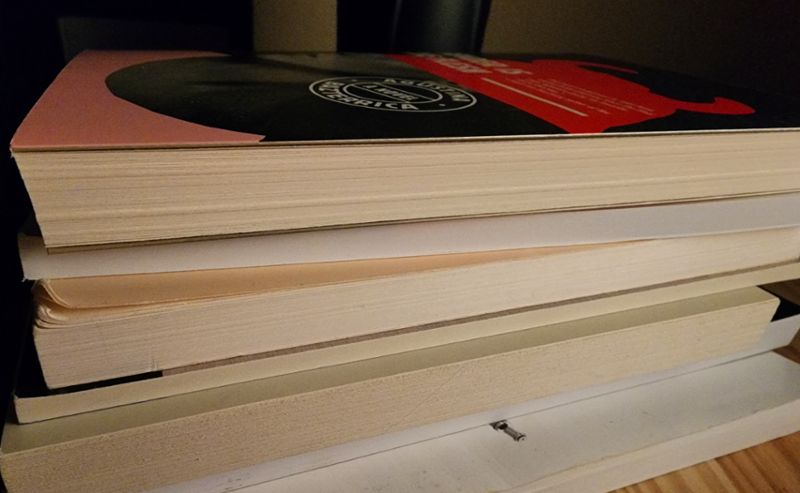
Quarantine
It's mind-expanding and challenging in the way that only Egan books are. Packed into a fun detective story are thoughts about quantum entanglement, death, life, free will , and the strange horror of something not being taken away from you, but added.
I loved the brutal interleaving of scenes when you realize that you're not following the "main" character, but instead one of the many unlucky ones that will "die" when the final eigenstate is chosen. You stay with them just long enough to soak in the fact that they're now aware that they're just waiting for "death," before finally hopping back to the perspective of the version who is "winning." It's effective both in the existential aspect, but also in solidifying these very wacky ideas about entanglement and superposition.
Quarantine is now a tight second behind Permutation City on my list of favorite Egan works.
This book ultimately sent me down the rabbit hole of quantum mechanics. I tried reading Feyman's QED book after this, but realized around page 50 that I'm to dumb. Instead, I picked up Quantum Computing for Everyone. It thankfully sticks with linear algebra and real numbers so that mouth breathers like myself can follow along. It's really good so far.
The idea of super-position is very unsettling to me. "Why would it be that way?" I feel a strange resistance to it that's almost like the bargaining stage of grief. " Surely they're missing something! A hidden variable somewhere...!" I don't know how to wrap my head around physical reality being probabilistic, and that waves collapse, and, if it's anything like the book, most of our conscious experience is a small sliver of that collapse.
Tender is the Flesh
This is the first time a book caught me off guard in a way that I had to set it down for a second to utter a "what the fuck?". At first, it's edge-lordy. Stratified society. Industrial-scale cannibalism. Surely some kind of heavy-handed comment on capitalism. Fine. Easy.
But then it offers a tour of a "factory."
It invites you into industrialized farming in a way that's depersonalized and cold and mechanical. The handling of "breeding stock" is the part that got me. I wasn't ready to read a sentence like "limbs surgically removed to prevent infanticide."
The ending is controversial, but perfect for its world. Like many good stories, it's so many things at once that it's hard to articulate.
That said, it relies on a heavy, heavy suspension of disbelief. It's a goofy premise if you sit around and think about it. Even the most effective parts are silly. But if you can maintain the suspension, it conveys a world that feels a certain way. It's lived in and grey.
Distress
Greg Egan is top tier, so I was surprised by how much this didn't land with me. It might be that I'm not smart enough to understand its core premise (which is something about the universe existing retroactively because someone exists in the future that comes up with a theory of everything. Or something like that). But there was also just a lot about this book that didn't work for me.
The first problem is that the main character is an unlikable dork. He's a science "journalist." That's strike one. The second problem is that the story made it a central plot point to have the main character record everything with his eyeballs rather than an external camera. Very sci-fi, I guess. But that means anytime he wants to record anything he has to stare at it. Maybe that's OK during a one-on-one interview, but for anything else, I mean, this guy is just leering at people from the corner? It's too goofy to imagine him not looking like a strange pervert all the time.
But the biggest problem for me was the dialog. Adverbs are trying hard to sell you on things the dialog isn't delivering. Reading this book was like having autism. The words made sense, but I couldn't process their emotions. I was endlessly confused about why character X was "offended" or whatever.I am not staring at you. I am capturing b-roll.
Anyways, some stuff happens. People do things. The main guy, who for some reason is smart enough to understand a Theory of Everything, does what "only a journalist can do," and communicates said Theory of Everything to the world.
And thus he creates the universe.
Or something like that.
What we can Know
The book is divided into two parts. The first is boring and tedious and way too long. Story wise, it needs to be there so that it can contextualize the second part, which is told from a different narrator's perspective. But instead of setting the context and moving on, it meanders around exploring the most uninteresting characters and inconsequential actions.
The world building in the first part is shallow. Something about AI and climate change and nuclear exchanges or something. Everything is bad now. Global warming raised the level of the oceans. Most animal life is extinct. People subsist on "greasy protein cakes" and drink "acorn coffee." And yet in this bleak post apocalyptic world, there are for some reason universities, and the humanities, and such an incredible surplus of resources such that they can pay a guy to spend his life "researching" a poem that was allegedly recited at a private dinner 100 years ago. Call me a philistine, but this struck me as silly.
Part 1's problems continue. The Big Dramatic moment for the main characters is when their students collectively announce that they won't be taking their class anymore because they don't want to learn about these idiots from 100 years ago. These people from the past are too barbaric and they hate them. The students leave.
This moment is world shattering to them. They're left "embarrassed" to the point where they can no longer speak to each other. Their marriage degrades after this.
As a reader, it's confusing. How does this post apocalyptic university work? Did the students who signed up for this hyper niche humanities class focusing on a specific 50 year period of time roughly 100 years ago not know that it would be about that specific period of time roughly 100 years ago? Why register for this class and then stage a walk out because the class is about a specific 50 year period of time roughly 100 years ago? More importantly, why did the teachers find this utterly embarrassing for themselves, rather than for the students behaving like children? "Walk out? Sure. No credits given."
That's the first part.
The second part is good. Still too long and too with much detail, but good. It shows everything that the researcher in the first part couldn't know despite his lifetime of research. This woman from the past that he "loves" is revealed not as the pious saint who gave up her career so that the poet could thrive, but as a complex, selfish, often profane human being.
It makes the first part of the book worth the slog. The character is multidimensional in a way that few that few books capture. She's filled with cognitive dissonance. She's narcissistic at times and deeply caring at others. She's fundamentally a coward. She cannot accept things she's done in the past. She blames others. Her final act is one of malice guided by emotions that are so human and conflicting that they cannot be cleanly categorized or articulated.
This is how you lose the time war
Mixed feelings. It overstays its welcome, but I enjoyed it enough to keep going. Mostly on the strength of the prose.
I picked this up because the little hand-written review in the bookstore pitched it as a time travel story that warrants multiple readings. I went in expecting Primer). I got The Notebook. So, my disappointment is mostly due to mismatched expectations. The "time travel" is just a plot device. It follows every time travel plot: bootstrapping.
Still, it's well written and cute for what it is.
Making Reliable Systems in the presence of software errors
Joe Armstrong's Ph.D thesis. It's roughly split into three parts: a philosophy of architecture, the Erlang language, and experience reports after putting these ideas in product at Ericson.
The first part is fantastic and worth reading for anyone interested in distributed systems. It begins with one of the most wonderful descriptions of software architecture I've ever encountered.
At the highest level of abstraction an architecture is a "a way of thinking about the world"
The way Erlang thinks about the world is concurrency and fault tolerance. To steal a quote from Michael Fogus[0], who is stealing a quote from Jim Gray, the thesis is "obvious and brilliant." You read and it and nod along. It articulates fundamental ideas about concurrency in casual, approachable prose.
To design and build a fault tolerant system, you must understand how the system should work, how it might fail, and what kinds of errors can occur
If design reviews focused on this, rather comparing different configurations of boxes and arrows, the world would be a far better place.
My one bummer with the thesis is that it doesn't go into the details of its dynamic code upgrade system. It's something that would have benefited from a discussion around its "philosophy" of architecture. As is, I wonder how much of it was about deployment problems that existed at the time versus him having a different perspective on what problem needs solved.
I've never used Erlang, so I've only lived in the world where "dynamic code upgrades" are an infrastructure problem. Updates roll through pipelines. Auto-scaling rules swap in changes at a rate of your choosing (and roll back if things go wrong). I wonder how different these two are in practice.
Berzerk
Berzerk was one of those foundational pieces of media for me. It was the first time I encountered a story that was dark. I don't even remember how I discovered it. I just remember being enthralled and then horrified upon realizing that there is no episode 26. You have to live with the taste of the final episode in your mouth.
I've never read the manga, so I dove into 30+ years of back issues.
The art gets better over time. The story gets worse. The Golden Age arc is the high water mark for the series. I think the fact that the original anime ends with the golden arc is what makes it so effective. You don't know what happens other than that everything is destroyed and Guts goes on to track down the apostles. That's a damn good ending because it's so unsatisfying. You're left wanting so much more.
But the manga keeps going. And becomes more "manga" as it goes. We get zany comic relief characters, 4th wall breaking, and even the Standard Issue Anime Kid whose arrival means that all danger or risk to the characters is gone. You also get massive personality shifts around chapter 150 or so. It becomes intolerably verbose in the way that only Japanese media seems to be. Everyone stands around explaining everything to the point of parody. In the Golden Age, Guts' dialog was mostly "...". That was awesome. The story happened around him. It was the best kind of punk rock.
Things get real rough towards the high 200s and onward. It turns into Scooby-Doo Adventure of the Week. Ghost pirates. Jonah and the Whale. Witches. Shamans. You name it, the book throws it at the wall while it meanders around going nowhere.
It's pretty to look at, though.
Footnotes: